
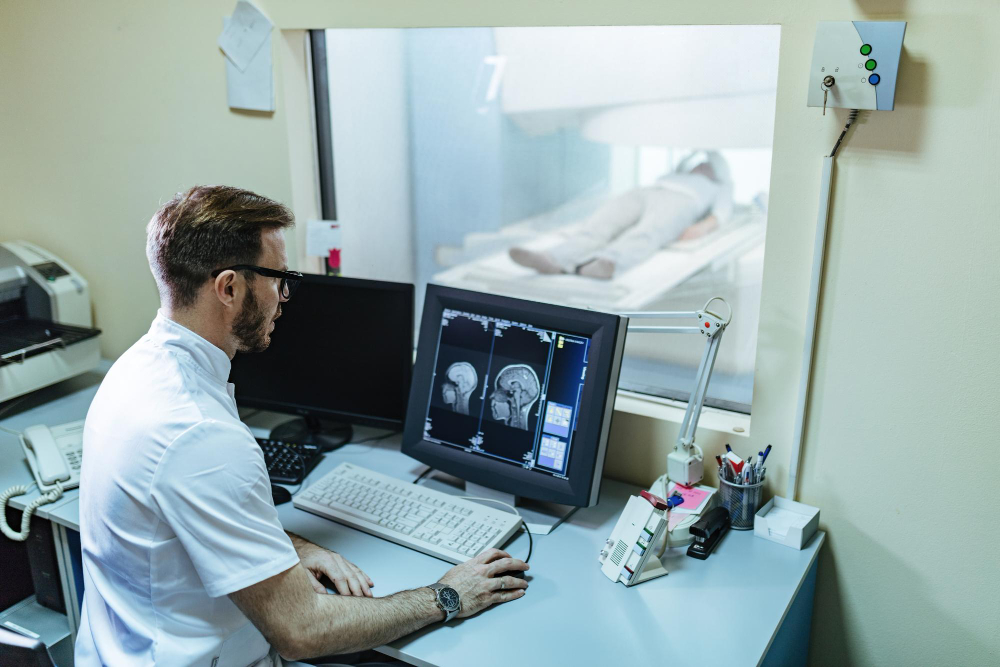
What Is a Contrast MRI?
A Contrast MRI is a special type of MRI scan. It uses a contrast agent to help doctors see inside the body more clearly. MRI stands for Magnetic Resonance Imaging. This test creates detailed pictures of organs and tissues. Sometimes, doctors need even clearer images. In these cases, they may use a contrast agent. For example, a doctor in New York might order a contrast MRI to check for brain tumors. Many hospitals across the country use contrast MRI for better results. While a regular MRI can show soft tissues, a contrast MRI highlights certain areas. This helps doctors spot problems they might miss otherwise.
How Do Contrast Agents Work?
Contrast agents are special dyes. When injected, they travel through your blood. Because of this, they make certain tissues stand out in the MRI images. As a result, doctors can see blood vessels, tumors, or inflammation more easily. For example, contrast agents help show if a tumor is getting blood from nearby vessels. In addition, they can highlight areas of infection. The contrast agent does not stay in your body for long. Usually, your kidneys remove it within a day. According to the U.S. Food and Drug Administration (FDA), these agents are safe for most people.
Reasons for Using Contrast Agents in MRI Scans
Doctors use MRI contrast agents for many reasons. Often, they need to see more detail than a regular MRI provides. For instance, contrast helps:
Sometimes, doctors use contrast MRI to plan surgery. In other cases, they use it to track how well treatment is working. Because contrast agents highlight certain areas, they help doctors make better decisions. According to the Radiological Society of North America, contrast MRI is often key for accurate diagnosis.
Types of Contrast Agents Used in MRI
There are several types of MRI contrast agents. Most often, doctors use gadolinium-based agents. Gadolinium is a rare metal. When mixed with other chemicals, it becomes safe for use in the body. Less often, doctors may use iron-based agents. These are sometimes used for people who cannot have gadolinium. Each type of agent works by changing how tissues look on the MRI scan. For example, gadolinium makes blood vessels and some tumors appear brighter. The choice of agent depends on your health and the type of scan needed. Your doctor will choose the safest option for you.
Safety and Side Effects of Contrast Agents
MRI with contrast safety is important. Most people have no problems with MRI contrast agents. However, some may have mild side effects. These can include:
Serious reactions are rare. But, people with kidney problems should tell their doctor before the scan. In rare cases, gadolinium can cause a condition called nephrogenic systemic fibrosis (NSF). The American College of Radiology states that this is very uncommon. Pregnant women should also discuss risks with their doctor. Overall, MRI with contrast is considered safe for most people.
What to Expect During a Contrast MRI
Before the scan, a nurse or doctor will ask about allergies and kidney health. Then, they will place an IV in your arm for the contrast agent. During the scan, you will lie still on a table. The MRI machine makes loud noises, but you will get earplugs or headphones. After the first set of images, the contrast agent is injected. Next, more images are taken. The whole process usually takes 30 to 60 minutes. Afterward, you can go home and return to normal activities. Drinking water helps your body remove the contrast agent. Most people feel fine after a contrast MRI. If you have any concerns, always consult at Chinmay MRI Scan.